Vitiligo management is anchored in 3 primary treatment goals1,2

Talk to your patients about these treatment goals.1-3

1

A first step

Stopping the immune attack

2

A visible milestone

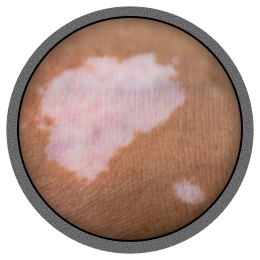
Repigmentation

3

An ongoing commitment

Maintaining repigmentation

These treatment goals can apply to both nonsegmental and segmental vitiligo.

Vitiligo is unpredictable and disease activity can fluctuate over time.

Stopping the immune attack means:

  • The immune system's attack on melanocytes has been interrupted
  • Vitiligo-related inflammation has been reduced

Delaying the stop of the immune attack:

  • Could risk further melanocyte destruction
  • Could contribute to new patches
  • Could risk future depigmentation in hard-to-treat areas

Help your patients understand why stopping the immune attack is an important first step in treatment.

LOOK DEEPER THAN PIGMENT:

Conversation topics to consider for your next patient visit

Ensure your patients understand the importance of these 3 primary treatment goals:

  • For many patients with vitiligo, repigmentation is a key treatment goal.
  • Repigmentation takes months.8 Encourage them with consistent follow-ups, and talk through progress that you see.
  • Take pictures in the same lighting at every visit so you can help them track treatment progress and monitor their disease for any progression.
  • You can work together to develop a treatment plan accordingly.


Keep these topics for future use—download a PDF or email them to yourself or your vitiligo patients.

Find resources here that can help guide conversations with your patients.

References

  1. Hlača N, Žagar T, Kaštelan M, Brajac I, Prpić-Massari L. Current concepts of vitiligo immunopathogenesis. Biomedicines. 2022;10(7):1639. doi:10.3390/biomedicines10071639
  2. Abdel-Malek ZA, Jordan C, Ho T, Upadhyay PR, Fleischer A, Hamzavi I. The enigma and challenges of vitiligo pathophysiology and treatment. Pigment Cell Melanoma Res. 2020;33(6):778-787. doi:10.1111/pcmr.12878
  3. Birlea SA, Goldstein NB, Norris DA. Repigmentation through melanocyte regeneration in vitiligo. Dermatol Clin. 2017;35(2):205-218. doi:10.1016/j.det.2016.11.015
  4. Rosmarin D, Soliman AM, Marwaha S, et al. Disease course, treatment patterns and goals among patients with non-segmental vitiligo across Europe and the United States. Dermatol Ther (Heidelb). 2024;14(7):1945-1957. doi:10.1007/s13555-024-01212-1
  5. Delbaere L, Duponselle J, Herbelet S, Speeckaert R, van Geel N. Predictive value of disease activity signs in vitiligo: an observational study. Exp Dermatol. 2024;33(9):e15167. doi:10.1111/exd.15167
  6. van Geel N, Speeckaert R, Taïeb A, et al. Worldwide expert recommendations for the diagnosis and management of vitiligo: position statement from the International Vitiligo Task Force part 1: towards a new management algorithm. J Eur Acad Dermatol Venereol. 2023;37(11):2173-2184. doi:10.1111/jdv.19451
  7. Das K, Sarkar R, Sinha S. Recent advances in management of vitiligo. Indian J Dermatol. 2025;70(4):201-207. doi:10.4103/ijd.ijd_158_25
  8. Seneschal J, Bae JM, Ezzedine K, et al. Vitiligo. Nat Rev Dis Primers. 2025;11(1):85. doi:10.1038/s41572-025-00670-x
  9. Speeckaert R, van Caelenberg E, Belpaire A, Speeckaert MM, van Geel N. Vitiligo: from pathogenesis to treatment. J Clin Med. 2024;13(7):5225. doi:10.3390/jcm13175225
  10. Xu X, Zhang C, Jiang M, Xiang LF. Impact of treatment delays on vitiligo during the COVID-19 pandemic: a retrospective study. Dermatol Ther. 2021;34(4):e15014. doi:10.1111/dth.15014
  11. Chang W-L, Lee W-R, Kuo Y-C, Huang Y-H. Vitiligo: an autoimmune skin disease and its immunomodulatory therapeutic intervention. Front Cell Dev Biol. 2021;9:797026. doi:10.3389/fcell.2021.797026.
  12. Falabella R. Vitiligo and the melanocyte reservoir. Indian J Dermatol. 2009;54(4):313-318. doi:10.4103/0019-5154.57604
  13. Kitchen H, Wyrwich KW, Carmichael C, et al. Meaningful changes in what matters to individuals with vitiligo: content validity and meaningful change thresholds of the Vitiligo Area Scoring Index (VASI). Dermatol Ther (Heidelb). 2022;12(7):1623-1637. doi:10.1007/s13555-022-00752-8
  14. Bae JM, Zubair R, Ju HJ, et al. Development and validation of the fingertip unit for assessing Facial Vitiligo Area Scoring Index. J Am Acad Dermatol. 2022;86(2):387-393. doi:10.1016/j.jaad.2021.06.880
  15. Gandhi K, Ezzedine K, Anastassopoulos KP, et al. Prevalence of vitiligo among adults in the United States. JAMA Dermatol. 2022;158(1):43-50. doi:10.1001/jamadermatol.2021.4724